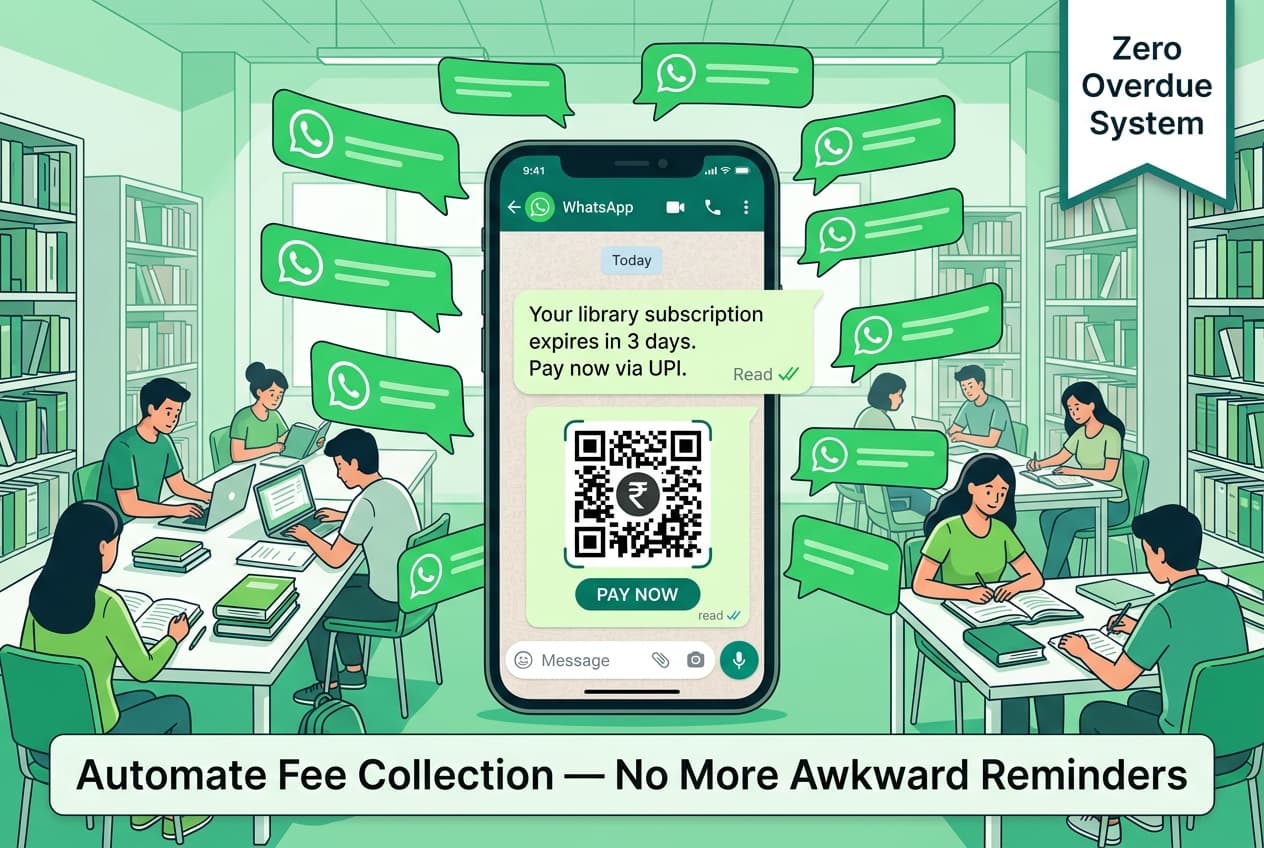

Chasing fee dues over phone calls is one of the most disliked parts of running a private study library — awkward for the owner, embarrassing for the student, and easy to keep postponing on both sides. A structured, automated fee-collection framework removes the awkward conversation entirely by moving reminders and payment confirmations onto WhatsApp, where students already are.
This guide lays out a complete 4-stage system — from the pre-expiry alert to the expiry-day access lock — that Indian library owners use to reduce overdue payments close to zero without a single manual follow-up call.
In This Framework
1. The 4-Stage Zero-Overdue Payments System
Rather than reacting to a missed payment after the fact, this framework front-loads reminders before the expiry date so most students renew on their own, without ever needing a phone call:
| Stage | Timing | Action |
|---|---|---|
| 1. Pre-Expiry Alert | 3 days before expiry | Automated WhatsApp message with UPI QR code attached |
| 2. Expiry-Day Reminder | Day of expiry | Final reminder with a direct payment link |
| 3. Grace Period | 1-2 days after expiry | Seat held, one final courtesy reminder sent |
| 4. Auto-Lock | After grace period | Seat marked inactive/released automatically, no manual tracking needed |
The key design principle is that the owner never has to remember who owes what — every stage fires automatically based on each student's individual subscription date, and payment confirmation via UPI updates the record instantly, cancelling any further reminders for that student.
2. The Real Revenue Impact of Overdue Fees
Libraries relying on manual tracking — a notebook or a mental list of who's due — typically lose 10-15% of monthly billable revenue to forgotten renewals, delayed follow-ups, and students who simply drift away without a formal cancellation. On a 100-seat library billing ₹1,00,000-₹1,50,000/month, that translates to ₹10,000-₹22,500 in monthly revenue leakage that a structured reminder system directly recovers.
This leakage compounds silently because it rarely shows up as a single visible loss — it's a few students here and there each month who simply stop paying without formally leaving, and whose seats then sit half-tracked for weeks before anyone notices. Over a full year, that steady trickle is often larger than any single expense line in the library's budget, which is why fixing it typically has a faster payback than almost any other operational change an owner can make.
3. Reminder Message Templates That Work
Tone matters — a reminder that feels like a courtesy notice gets a better response than one that feels like a warning. Effective templates are short, specific, and include a direct action:
- 3-day pre-expiry: "Hi [Name], your seat subscription at [Library] expires on [Date]. Renew now via UPI to keep your seat reserved: [QR/Link]."
- Expiry-day: "Your subscription expires today. Pay now to avoid losing your reserved seat: [Link]."
- Grace period: "We've held your seat for 2 extra days. Please renew by [Date] to keep it."
- Payment confirmation: "Payment received — thank you! Your subscription is now active until [New Date]. Receipt attached."
4. Cash vs UPI Fee Tracking
Cash payments still make up a meaningful share of fee collection in many Indian libraries, particularly in smaller towns, but they require manual entry into the system to keep records accurate — a step that's easy to skip during a busy shift. UPI payments through a QR code update the ledger automatically the moment payment clears, removing that manual step and its associated error risk entirely. A hybrid approach — accepting both, but defaulting communication and receipts to WhatsApp regardless of payment method — captures the convenience of digital tracking without forcing students who prefer cash to change habits.
Over time, most libraries see their UPI share grow naturally once students experience how quickly a scan-and-pay renewal works compared to handing over cash and waiting for a handwritten receipt. Owners don't typically need to push students toward UPI directly — offering both and letting the friction difference speak for itself is usually enough.
5. Collecting Advance Fees to Reduce Follow-Up Load
Offering a modest discount (5-10%) for 3-month or 6-month advance payment, rather than strict month-to-month billing, meaningfully cuts the number of renewal cycles — and therefore reminder messages and potential lapses — a library has to manage per student per year. Many owners find that converting even 30-40% of their student base to quarterly or half-yearly billing significantly reduces the operational load of the reminder system above, while also improving cash flow predictability.
The best time to offer this upgrade is at the moment of a successful renewal, when a student has just paid and is receptive to a small additional discount for committing further ahead, rather than as a cold pitch mid-month. Framing it as "lock in this month's rate for the next 6 months" also protects the student from a mid-term price increase, which is a genuine value proposition rather than just a sales tactic.
6. Frequently Asked Questions
How much revenue do libraries lose to overdue fees?
Libraries relying on manual tracking typically lose 10-15% of monthly billable revenue to forgotten renewals and delayed follow-ups — a structured WhatsApp reminder system directly recovers most of this.
How do I stop fee defaults without arguing with students?
Use an automated 4-stage reminder system — a pre-expiry WhatsApp alert, an expiry-day reminder, a short grace period, and an automatic seat lock — so reminders feel routine rather than confrontational, and no manual phone call is needed.
Can I send payment receipts automatically on WhatsApp?
Yes. Apps like Librify send an automated WhatsApp receipt the moment a UPI payment clears, without any manual step from the library owner or staff.
Should I accept cash or only UPI for library fees?
Most libraries accept both, but default automated receipts and reminders to WhatsApp regardless of payment method, and log cash payments into the app immediately to keep records accurate.
Related reading: WhatsApp Receipts: The Fastest Way to Get Paid on Time and Never Miss a Fee Renewal: Subscription Tracking for Libraries.
Automate Your Fee Reminders on WhatsApp
Pre-expiry alerts, UPI QR payments, and instant receipts — no manual follow-up calls.
Try Librify Free →