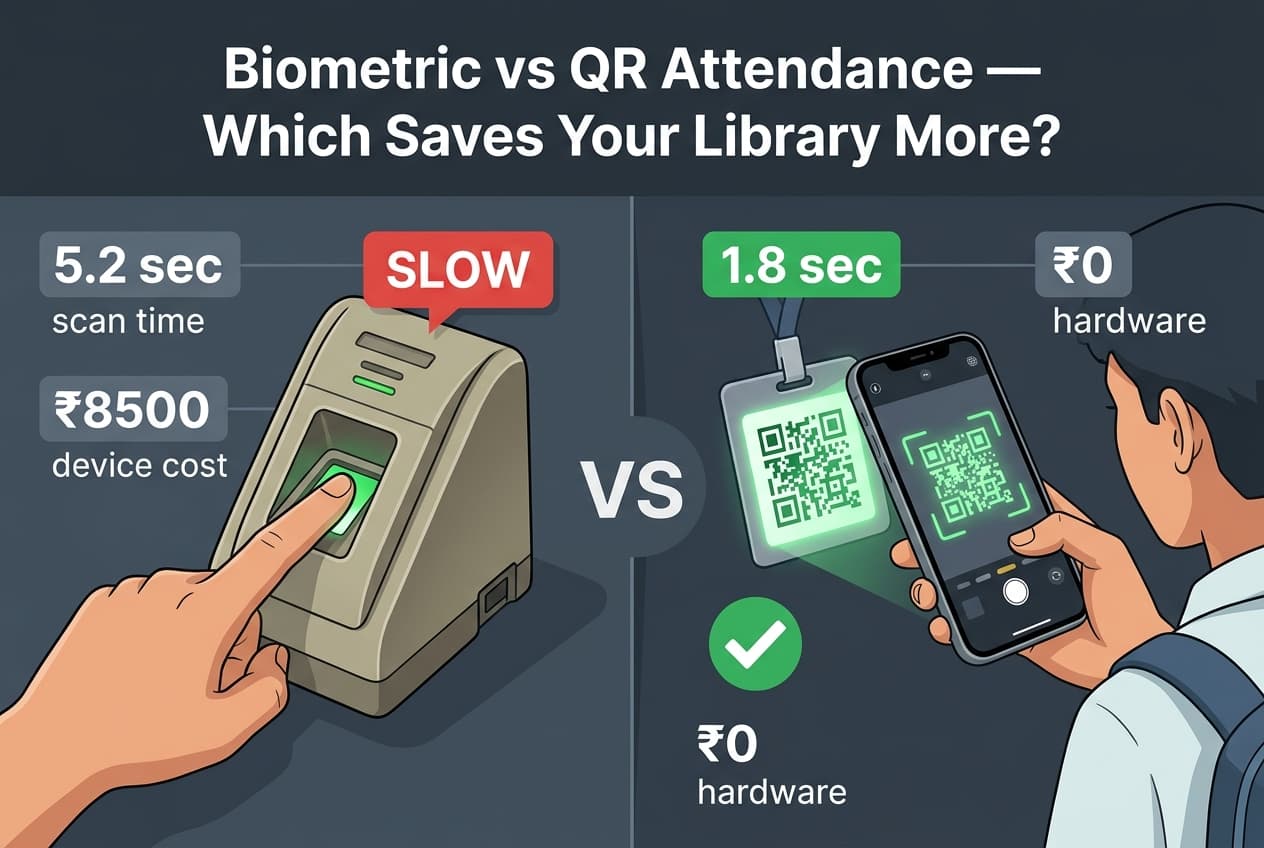

Attendance hardware decisions get made once and lived with for years, so the real comparison isn't feature checklists — it's the actual 1-year cost, scan speed in seconds, and how often each system fails under everyday use. This guide runs the numbers on biometric fingerprint machines versus QR-based attendance for Indian private study libraries.
Both systems solve the same core problem — proving a student actually showed up for their booked seat — but they arrive at very different total costs once hardware, maintenance, and failed-scan retries are counted over a full year.
This matters most for multi-branch owners, since biometric costs scale linearly with every new location — a fresh device, fresh installation, fresh annual maintenance contract — while QR attendance software cost stays essentially flat regardless of how many branches are added under a Pro plan.
In This Cost Comparison
1. The Real 1-Year Cost: Biometric vs QR
Biometric machines look like a one-time hardware purchase, but repairs, sensor replacements, and per-branch duplication add up fast. QR attendance uses phones students already own, so the ongoing cost is close to zero:
| Cost Item | Biometric Machine | QR Code Attendance |
|---|---|---|
| Hardware (per branch) | ₹4,500 – ₹9,000 | ₹0 (uses student phones) |
| Installation & wiring | ₹500 – ₹1,500 | ₹0 (print one QR poster) |
| Annual maintenance/repair | ₹1,000 – ₹2,500/year | ₹0 |
| Software/app | Often bundled, limited features | Free plan available (Librify) |
| Total Year 1 Cost (single branch) | ₹6,000 – ₹13,000 | ₹0 – ₹708 (Mini plan) |
Biometric costs multiply per branch since hardware isn't shareable; QR attendance software cost stays flat regardless of branch count on the Pro plan.
2. Scan Speed & Failure Rates
Speed and reliability matter most during peak entry times — the first 15 minutes of a shift when most students arrive together. A slow or failing attendance system creates a queue at the door, which itself becomes a friction point for students choosing between libraries.
The failure-rate gap compounds during peak hours specifically. If 40 students arrive within a 15-minute morning window and 10-15% of biometric scans fail on the first attempt, that's 4-6 students needing a second or third try — each adding several seconds to the queue and creating exactly the bottleneck a library wants to avoid at its busiest moment. QR's sub-1% failure rate means this bottleneck effectively disappears.
| Metric | Biometric Fingerprint | QR Code Scan |
|---|---|---|
| Average scan time | 4 – 6 seconds | ~1.8 – 2 seconds |
| Failed-scan rate | 10% – 15% | Under 1% |
| Common failure cause | Sweaty, dry, or worn fingerprints | Poor lighting or camera focus (rare) |
| Works during power cut | ✗ Device needs power | ✓ Phone-based, works on battery |
3. Privacy & Data Considerations
Biometric systems store fingerprint or facial data — a form of sensitive personal data that carries real storage and consent obligations under Indian data protection norms, and one that many students, especially government-exam aspirants who are cautious about their data, are uncomfortable handing over to a private business. QR attendance only records a timestamp and a check-in event, with no biometric data collected or stored at all.
This distinction matters commercially too, not just legally. Some prospective students specifically ask during admission whether a library takes fingerprint or face data, and a "no" answer removes a hesitation point that biometric-using libraries have to actively overcome during enrollment conversations.
4. Does QR Attendance Prevent Proxy Check-Ins?
A common objection to QR attendance is that a student could ask a friend to scan on their behalf. In practice, this risk is manageable and often overstated: a desk-mounted QR code combined with a visible seat map means staff can visually confirm a mismatch between who scanned and who is physically seated, which is the same manual check most biometric setups also rely on when a fingerprint fails and staff override the entry manually. For libraries wanting stricter control, some apps support geofenced or time-windowed QR codes that regenerate periodically, making a shared screenshot ineffective.
It's also worth noting that biometric systems have their own, less-discussed proxy vulnerability: a shared staff override PIN, used whenever a fingerprint scan fails, effectively becomes a manual bypass that any staff member can use for any student — a workaround that happens often enough in practice to undercut the "unforgeable" reputation biometric attendance is usually sold on.
5. How to Set Up QR Attendance in Your Library
- Generate your library's QR code: Create a unique attendance QR code for your branch inside the app.
- Print and mount it at the entrance: A laminated A4 printout at the front desk or entry gate is sufficient.
- Ask students to scan on arrival and departure: A quick camera scan logs check-in and check-out timestamps automatically.
- Review attendance on your dashboard: See daily attendance, no-shows, and shift-wise occupancy without any manual entry.
6. Frequently Asked Questions
Is QR attendance cheaper than biometric for a library?
Yes. Biometric machines typically cost ₹6,000-₹13,000 in year one per branch including hardware, installation, and maintenance, while QR attendance software can cost as little as ₹0-₹708/year since it uses students' own phones as scanners.
How much faster is QR attendance than biometric?
QR scans average about 1.8-2 seconds versus 4-6 seconds for a fingerprint scan, and QR has a failed-scan rate under 1% compared to 10-15% for biometric sensors on sweaty or worn fingerprints.
Does QR attendance store biometric data?
No. QR attendance only records a check-in/check-out timestamp — no fingerprint, face, or other biometric data is collected or stored.
Can biometric attendance work during a power cut?
No, most biometric devices need continuous power to operate. QR attendance works on a student's phone battery, so it continues functioning during outages.
Related reading: QR Attendance vs Biometric: What's Right for Your Library and Library Attendance System: Complete Guide.
Switch to Zero-Hardware QR Attendance
No machines to buy or repair — just a QR code and the phone your students already carry.
Try Librify Free →