
Before you put up a "Library" signboard, a private study library or reading room in India needs to clear a specific set of legal registrations — most of which are simpler and cheaper than new founders expect. Skipping them risks fines, forced closure notices from local municipal authorities, or an inability to open a business bank account or accept digital payments cleanly.
This guide walks through the exact 5-step registration process for a private study library in India, including which licenses actually apply, when GST becomes mandatory, and how the process differs slightly across states like Uttar Pradesh, Bihar, and Rajasthan.
In This Legal Guide
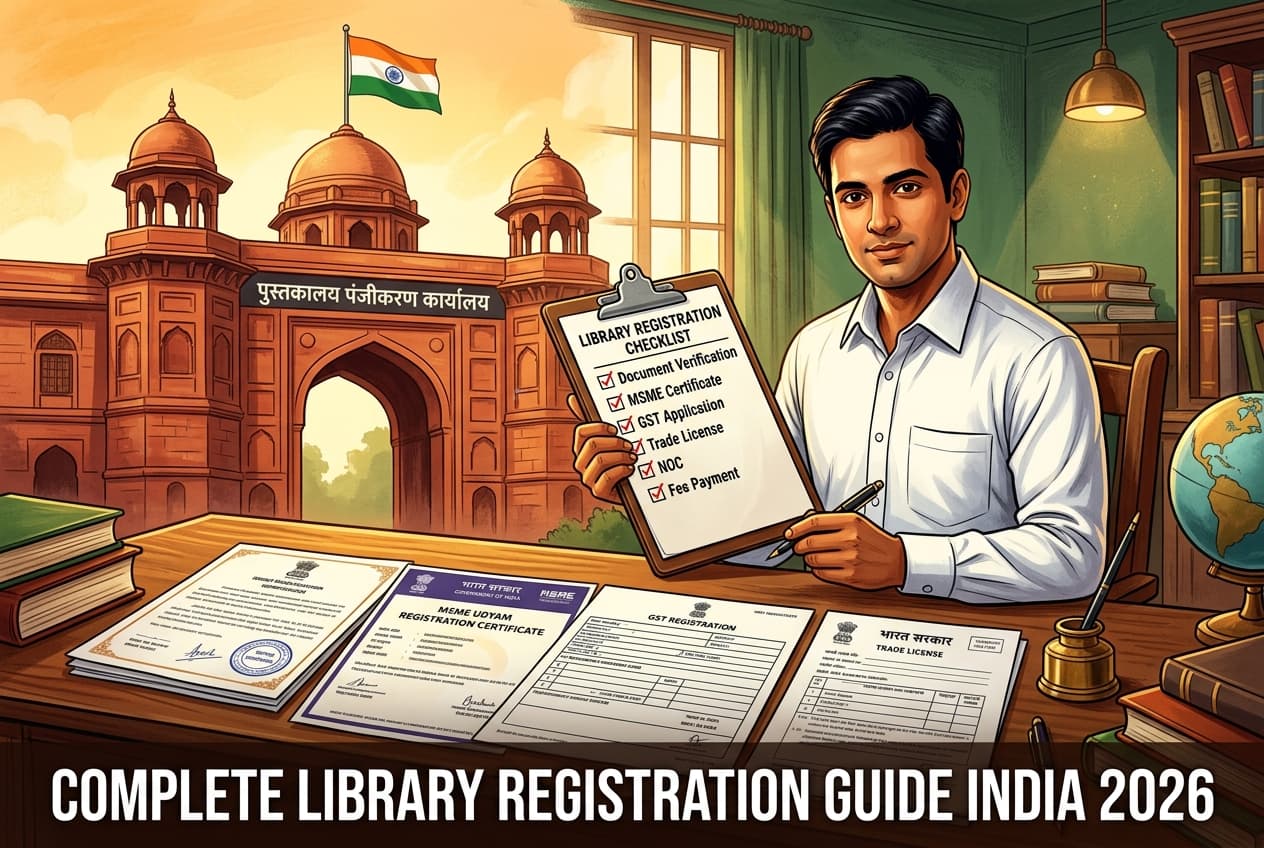
1. The 5-Step Library Registration Process in India
| Step | Registration | Typical Cost | Why It's Needed |
|---|---|---|---|
| 1. Shop & Establishment Act | Municipal/local body registration | ₹500 – ₹3,000 | Legally required to operate any commercial establishment employing staff. |
| 2. Udyam/MSME Registration | Online via Udyam portal | Free | Unlocks collateral-free business loans, subsidies, and MSME benefits. |
| 3. Trade License | Municipal corporation | ₹1,000 – ₹5,000/year | Confirms the premises is approved for commercial/reading-room use. |
| 4. Fire NOC | Local fire department | ₹1,000 – ₹10,000 (size-dependent) | Often required once seating exceeds a locally-defined occupancy threshold. |
| 5. GST Registration (if applicable) | GST portal | Free | Mandatory only above the ₹20-40 Lakh annual turnover threshold (see below). |
2. Choosing a Business Structure: Trust vs Proprietorship vs Partnership
Most single-owner private study libraries register as a sole proprietorship — simplest paperwork, single PAN-linked GST if needed, and full control. A partnership or LLP suits co-founders splitting ownership. A trust or society structure is used mainly by libraries positioning themselves as educational/charitable institutions, which can unlock specific tax exemptions but adds governance overhead (trustees, meeting minutes) not worth it for a single-branch commercial reading room.
Switching structures later — for example, converting a sole proprietorship into an LLP once a second co-founder joins, or once the business scales past a single branch — is a fairly standard legal process and not something that should block your initial decision. Most owners start as a sole proprietorship precisely because it can be formalized in a single sitting, and revisit the structure only once the business has proven itself.
3. Is GST Required for a Self-Study Library in India?
Direct answer: No, GST registration is not mandatory for a private study library with annual turnover under ₹20 Lakhs (₹10 Lakhs in some special-category states), or under ₹40 Lakhs for goods-only businesses. Most single-branch libraries charging ₹800-₹1,500 per seat per month stay well under this threshold in their first 1-2 years. Once turnover crosses the limit, GST registration becomes mandatory, and seat-fee income is typically taxed under the applicable service category rate.
It's worth tracking your rolling annual turnover even before you hit the threshold, since crossing it triggers a compliance deadline — GST registration is required within 30 days of exceeding the limit, and operating past that window without registering can attract penalties. A library that expands to a second branch or scales seat count significantly should re-check this calculation regularly rather than assuming last year's exemption still applies.
4. Documents Required to Open a Library in India
Keeping these ready before you begin the registration process avoids repeat visits to municipal offices, which is the most common cause of delays:
- PAN card and Aadhaar card of the owner/proprietor
- Proof of business address (rent agreement + electricity bill or property tax receipt)
- Passport-size photographs
- Bank account details for the business
- NOC from the landlord (if the premises is rented)
- Fire safety certificate (once required by local body rules)
If you plan to apply for Udyam/MSME registration alongside the Shop & Establishment Act filing, having your bank account and PAN details ready in advance lets you complete both in the same sitting, since Udyam registration is entirely online and typically takes under 15 minutes once the documents are on hand.
5. State-Wise Registration Variations (UP, Bihar, Rajasthan)
The core 5-step process above applies nationally, but processing timelines and specific municipal forms vary by state. Uttar Pradesh and Bihar municipal corporations generally process Shop & Establishment registrations online within 7-15 working days. Rajasthan's process is similarly online via its e-Mitra portal. In all three states, Udyam/MSME registration is identical since it is a central government portal, not state-specific.
Commercial electricity connections are another state-level variable worth budgeting for early. Most municipal bodies classify a study library as a commercial establishment once it crosses a certain floor area or seat count, which means a switch from a domestic to a commercial electricity tariff — typically 20-40% higher per unit. Factoring this into your monthly opex estimate from day one avoids an unpleasant surprise once the local electricity board reclassifies the connection.
6. After Registration: Moving to Digital Records
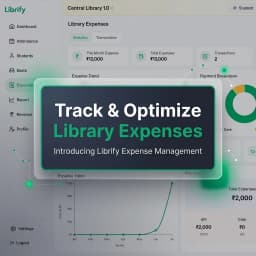
Once your library is legally registered, most municipal and tax authorities expect clean, auditable student and revenue records — something a paper register makes difficult to produce on demand. Managing all student records, attendance, and fee collection digitally on an app like Librify from day one makes any future tax audit, MSME loan application, or municipal inspection considerably smoother.
This matters most at two specific moments: when applying for an MSME collateral-free loan, where lenders typically ask for revenue history, and during a routine municipal or fire-safety inspection, where an up-to-date digital occupancy record demonstrates the library is operating within its declared seat capacity. Owners who only maintain paper records often lose several days scrambling to reconstruct this information under time pressure.
7. Frequently Asked Questions
Does a private self-study library need GST in India?
No, not below the ₹20-40 Lakh annual turnover threshold depending on the state and business category. Most single-branch libraries in their early years stay exempt.
What is the first registration a new library owner should get?
Shop & Establishment Act registration with the local municipal body, since it is the base legal requirement for operating any commercial establishment with staff.
Is Udyam/MSME registration mandatory for a library?
Not mandatory, but strongly recommended — it is free, takes minutes online, and unlocks collateral-free loan schemes and other MSME benefits for the business.
Do I need a trust to run a study library?
No. A sole proprietorship is sufficient and simplest for most single-owner commercial study libraries. A trust structure is only useful for libraries positioned as educational/charitable institutions.
Related reading: How to Start a Library Business in India and Study Library ROI Blueprint.
Once Registered, Manage Everything Digitally
Keep clean student and revenue records from day one — no paper registers.
Try Librify Free →