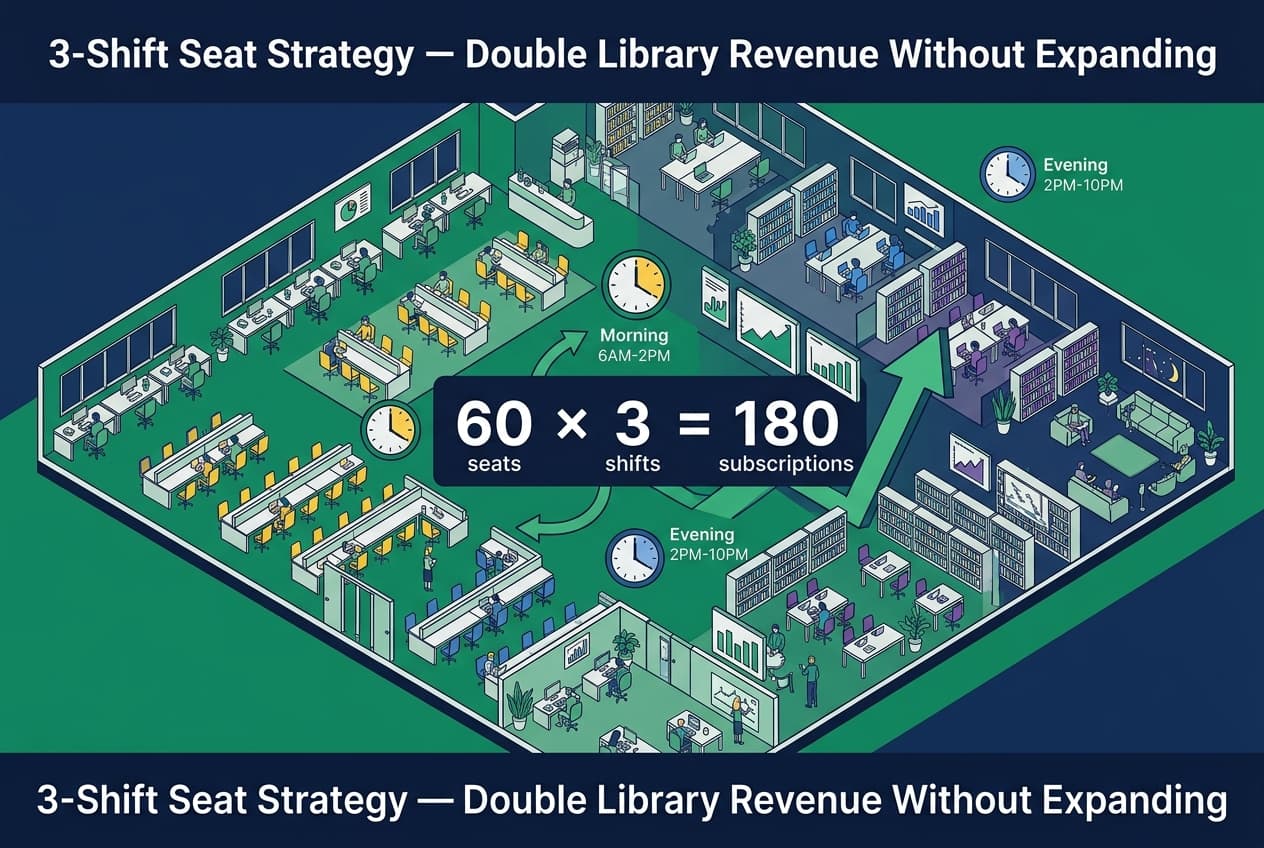

The single biggest revenue lever most private study library owners overlook isn't more seats — it's more shifts on the seats they already have. A physical seat sitting empty from 10 PM to 6 AM is unbooked capacity, and unbooked capacity is money left on the table every single day.
This guide walks through the exact seat-mapping math behind a 3-shift booking model, using a real 70-seat library as the working example, and shows how the same floor area can generate revenue equivalent to a 140+ seat single-shift library.
The math works because a study seat, unlike a hotel room, doesn't need cleaning turnaround or overnight vacancy between bookings — a student leaves at the end of their shift and the next student's window simply begins, making the seat effectively always productive rather than idle for two-thirds of the day.
In This Guide
1. The 70-Seat, 3-Shift Revenue Math
Take a 70-seat library running three non-overlapping shifts: Morning (6 AM-2 PM), Evening (2 PM-10 PM), and Night (10 PM-6 AM). Each seat can be booked separately for each shift by a different student, since the booking windows never overlap:
| Shift | Timing | Seats Bookable | At 80% Occupancy |
|---|---|---|---|
| Morning | 6 AM – 2 PM | 70 | 56 subscriptions |
| Evening | 2 PM – 10 PM | 70 | 56 subscriptions |
| Night | 10 PM – 6 AM | 70 | 42 subscriptions (60% typical) |
| Total Active Subscriptions | — | 210 seat-slots | ~154 paying students |
154 paying students on 70 physical seats is equivalent to running a 154-seat single-shift library — without renting a single extra square foot.
2. Choosing the Right Shift Timings
Shift boundaries should follow local student behavior rather than a generic 8-hour split. Morning shifts work well ending before lunch, since many students attend coaching classes in the afternoon. Evening shifts should extend into early night to capture students studying after work or classes. A dedicated night/24x7 shift captures the aspirant segment — often preparing for UPSC, SSC, or banking exams — who specifically seek distraction-free, quiet overnight hours unavailable at home.
It's worth surveying your own current students before finalizing shift boundaries rather than guessing — even a quick WhatsApp poll asking "what time would you use a night study slot?" often reveals demand patterns specific to your local coaching schedules that a generic 3-shift template won't capture.
3. Preventing Seat Clashes Across Shifts
The entire 3-shift model depends on zero overlap — a student's booking window must end cleanly before the next shift's student arrives. A real-time visual seat map that shows exactly which seats are booked, by whom, and for which shift removes the manual coordination that a paper register simply cannot handle at this complexity. Without digital seat tracking, most owners either avoid running 3 full shifts altogether, or run them with frequent clashes and student complaints — both of which cap the revenue this model can otherwise generate.
A short buffer window — 10-15 minutes between shifts — also helps in practice, giving the outgoing student time to leave and staff time to do a quick seat check before the next student's booking window formally begins. This small operational cushion prevents the exact overlap disputes that otherwise erode trust in a multi-shift system.
4. Cabin Seats vs Open Table Seating
Enclosed cabin seats support a higher per-seat fee (often ₹100-₹300 more per month) due to privacy and reduced distraction, making them well suited to premium, exam-focused libraries running fewer, higher-paying shifts. Open table seating fits more students per square foot and suits libraries prioritizing seat count and shift-volume over per-seat premium — often a better fit for the 3-shift model above, since it maximizes the raw number of bookable seat-slots.
Many libraries settle on a mixed layout — a smaller block of premium cabins alongside a larger open-table section — letting each seat type serve the shift pattern it's best suited to: cabins for focused Morning/Evening study blocks, open tables for the higher-volume Night shift where price sensitivity tends to be higher.
5. Night Shift Challenges & Practical Solutions
Night shifts introduce real operational questions: staffing overnight, security, and slightly higher electricity costs for continuous lighting and AC. Most owners solve staffing with a single overnight attendant rather than a full team, and address security with CCTV plus a locked entry that only opens via app-verified QR check-in — which also doubles as the attendance record for that shift. Occupancy typically starts lower (50-60%) for a new night shift and climbs over 2-3 months as word spreads among the local aspirant community that the option exists.
6. Frequently Asked Questions
How many students can a 70-seat library serve with 3 shifts?
At typical occupancy rates (80% for Morning/Evening, 60% for Night), a 70-seat library can serve roughly 154 paying students across 3 shifts — more than double a single-shift model.
How do I prevent seat booking clashes between shifts?
Use a real-time digital seat map that shows exactly which seats are booked by shift, rather than a paper register — this makes overlapping bookings visible and preventable before they happen.
Are cabin seats or open tables better for a multi-shift library?
Open tables typically fit more seats per square foot, maximizing the total bookable seat-slots across shifts, while cabin seats support a higher per-seat fee for privacy-focused, exam-prep libraries.
Is a night shift worth adding to a study library?
Yes, in cities with a strong competitive-exam aspirant base. Night shifts typically start at 50-60% occupancy and grow over 2-3 months, adding a third revenue stream on the same seats at minimal extra cost.
Related reading: Fill Every Seat: Smart Seat Management for Study Libraries and Multi-Shift Library Scheduling: A Profit Playbook.
See Your Real-Time Seat Map Across All Shifts
Visualize vacant seats by shift and stop turning away bookings you actually have room for.
Try Librify Free →