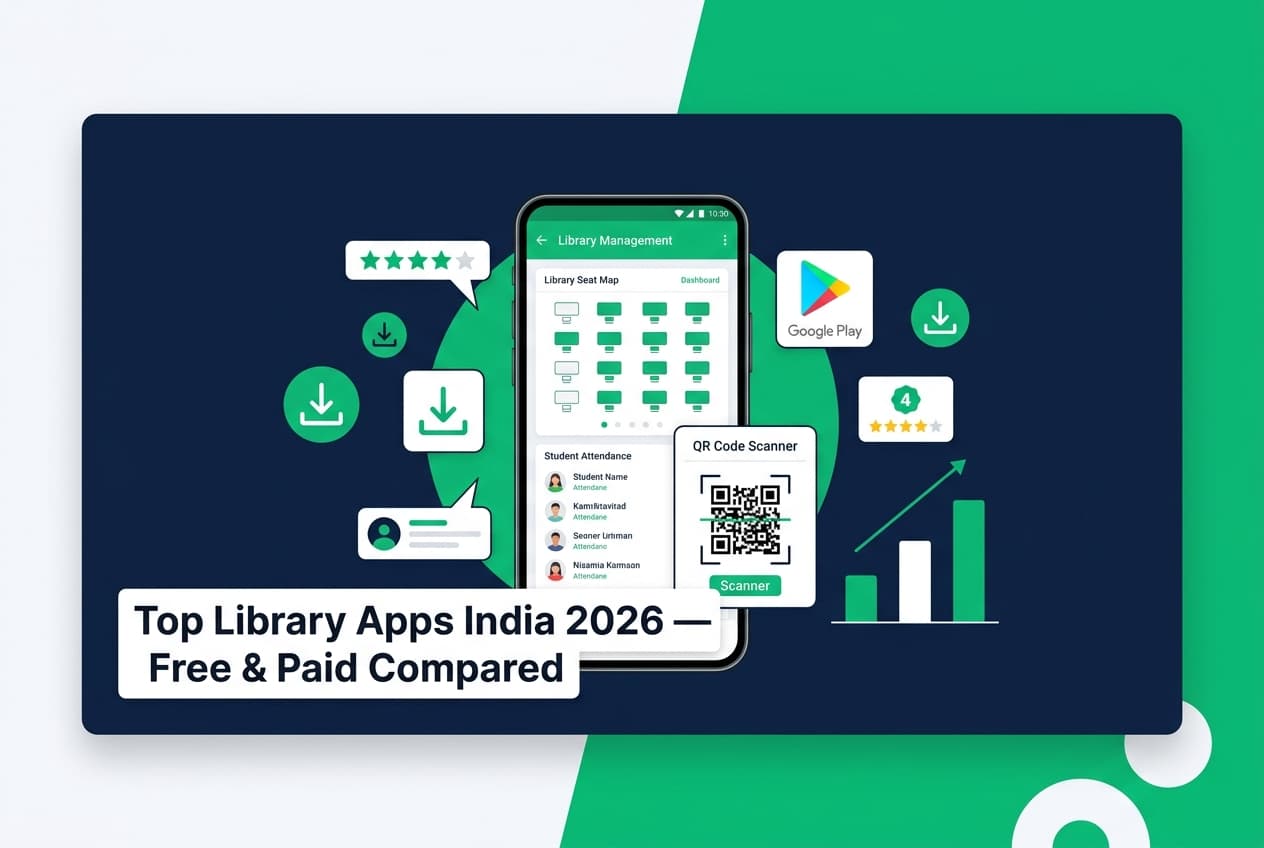

Choosing the right library management app decides how much time you spend chasing fee dues, marking attendance by hand, and reconciling cash registers each night. India's private study library market now has a genuine spread of options — from ₹0 free-forever apps to enterprise campus systems — and picking the wrong one either wastes money on features you'll never touch or leaves you back on paper registers within a month.
This guide compares the leading library management apps available on the Google Play Store and web by price, QR attendance speed, seat booking, and fee automation — including where Librify's free plan and paid Mini/Pro tiers fit against manual registers and other cloud apps.
In This Comparison Guide
1. Library Management App Comparison Table (India, 2026)
Here is an objective, feature-by-feature comparison of the main ways Indian study library and reading room owners manage students today — from a plain paper register to dedicated cloud apps:
| Solution | Monthly Cost | QR Attendance | Seat Booking | WhatsApp Automation |
|---|---|---|---|---|
| Paper Register | ₹0 (hidden labor cost) | ✗ Manual, error-prone | ✗ No real-time view | ✗ Phone calls only |
| Excel / Google Sheets | ₹0 – ₹500/mo | ✗ No attendance layer | ✗ Manual cell edits | ✗ Not automated |
| Librify (Free Plan) | ₹0/month | ✓ QR-based, ~2 sec scan | ✓ Visual seat map | Basic reminders only |
| Librify Mini | From ₹59/month | ✓ QR-based, ~2 sec scan | ✓ Multi-shift seat map | ✓ Payment receipts |
| Librify Pro | From ₹149/month | ✓ QR-based, multi-branch | ✓ Unlimited branches | ✓ Renewal + due alerts |
| Legacy Campus/ERP Software | ₹1,500 – ₹5,000+/mo | Biometric hardware needed | Built for book-lending, not seats | ✗ Rarely included |
2. What to Actually Look For in a Library Management App
Many library owners get tempted by feature-heavy apps built for college and university campuses — book cataloging, ISBN barcode scanning, inter-library loan tracking. None of that is relevant to a private study library or reading room, where students rent a seat and bring their own books. Buying that kind of software means paying for, and learning to navigate, an interface built for a completely different business. Most Indian private study libraries and reading rooms need exactly four things — and nothing more:
QR-Based Attendance
No biometric hardware to buy or repair — a student's own phone camera scans a desk QR code in about 2 seconds.
Multi-Shift Seat Booking
A visual map showing which seats are booked in the Morning, Evening, and Night shifts, so one seat can serve 2-3 paying students a day.
WhatsApp Fee Automation
Automatic payment receipts and subscription-expiry reminders sent over WhatsApp — no awkward phone calls chasing dues.
Daily Collection Reports
One-tap Excel/PDF export of daily cash and UPI collections for your own records or your CA's tax filing.
3. Free vs Paid: Where Each Tier Actually Fits
A free-forever plan (₹0/month) is enough for a single-branch library under roughly 40-50 seats that just needs QR registration, a seat map, and basic attendance. Once you need automated WhatsApp payment receipts, expense tracking, or daily Excel/PDF exports for tax audits, a paid tier from ₹59/month (Librify Mini) covers a single branch comfortably. Multi-branch chains with several admin staff need the ₹149/month Pro tier for unlimited branches and admin accounts.
4. QR Attendance & Seat Booking Speed
Biometric fingerprint machines average 4-6 seconds per scan and fail roughly 10-15% of the time on sweaty or dry fingers, needing a repeat attempt. QR-based attendance on a smartphone camera scans in about 2 seconds with a near-zero failure rate, and needs zero hardware purchase or repair budget — the student's own phone is the scanner.
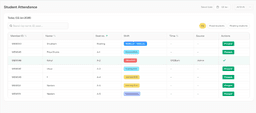
Seat booking speed matters just as much as attendance speed. A visual seat map that updates in real time lets front-desk staff assign a walk-in student to an open seat in seconds, rather than flipping through a paper diagram or asking students to check with each other about which seats are free. Over a busy admission season, this alone can save a library owner several hours a week that would otherwise go into manually reconciling who is sitting where across three overlapping shifts.
5. Google Play Store Ratings & Downloads
When you search "library app" or "library management app" on Google, Play Store app carousels increasingly appear directly in the search results. Librify is available free on the Google Play Store and is used by hundreds of private study libraries across India — ranking well both on web search and inside Play Store search results creates a closed-loop discovery funnel for new library owners.
For a library owner, this closed loop matters commercially: a prospective library owner researching software on Google discovers Librify through a blog post or comparison table, then installs it directly from the Play Store carousel without ever leaving the search results page. For students, the same app doubles as their own self-service portal — checking seat availability, subscription status, and payment history from their phone, which reduces front-desk queries for the library owner.
6. How to Switch From a Manual Register to a Library App
Owners often delay switching from paper registers because they assume it means re-entering years of student history by hand. In practice, the migration only needs your currently active students — those still paying and attending — not your entire historical register. Most libraries complete this in under 15 minutes:
- List your existing students: Write down names, shifts, and phone numbers from your current register or Excel file.
- Bulk-add or self-register students: Add them in the app in one go, or print a QR poster so existing students self-register from their own phones.
- Print the entry QR code: Place a single QR code at your front desk for daily attendance scanning.
- Turn on WhatsApp receipts: Announce to existing members that payment confirmations and renewal reminders will now arrive automatically on WhatsApp.
Running both systems in parallel for the first 7-10 days — the paper register as a backup and the app as the primary — is a low-risk way to build staff confidence before fully retiring the old process.
7. Frequently Asked Questions
Which is the best free library management app in India?
Librify's free-forever plan includes QR-based registration, a visual seat map, and basic attendance tracking at ₹0/month, making it a strong starting point for single-branch reading rooms before upgrading to paid features.
Do I need biometric hardware for attendance?
No. QR-based attendance apps like Librify use a student's own smartphone camera, so no fingerprint machine or hardware purchase is required.
How much does library management software cost in India?
Prices range from free to ₹5,000+/month. Librify's paid plans start from ₹59/month (Mini) and ₹149/month (Pro), while legacy campus/ERP software built for book cataloging can cost ₹1,500-₹5,000+/month.
Can one app handle multiple library branches?
Yes. Librify's Pro plan supports unlimited branches and unlimited owner/admin accounts from a single login, with centralized reporting across all locations.
Related reading: Best Free Library Management Apps in India and Complete Cost Guide: Library Software Prices in India.
Try the Free Plan Built for Indian Study Libraries
QR attendance, seat booking, and WhatsApp receipts — no hardware, no setup fees.
Try Librify Free →